Is Morse Code Still Used Today? A Real Look at Where It Survives in 2026
Morse code isn't dead. From aviation beacons to ham radio and search-and-rescue, here's exactly where it's still used today, and why it refuses to disappear.
Kalana Sandeep
Creator of Morse Code Translator
Is Morse Code Still Used Today?
Short answer: yes, but not the way it used to be.
Nobody is sending office memos in dots and dashes, and no navy fleet uses a telegraph key to coordinate their next battle. That era ended decades ago. But if you assume Morse code quietly hung up its hat sometime after World War II, you're wrong. All that happened was it became something else : cockpits, ham shacks, rescue boats, and surprising amounts of hobbyist workshops.
So let's take a look at where Morse code is still useful today, why it hasn't been entirely swept away by digital tech, and where it genuinely belongs to history. No vague explanations — only real-world examples and practical applications.
A Quick Refresher on What Morse Code Actually Is
Morse code is a method of encoding letters, numerals and punctuation as combinations of short and long signals; dots and dashes; "dits" and "dahs", if you're speaking with someone who actually uses it. The signal does not necessarily have to be sound. It could be in the form of light, a radio tone, tapping a table or even a blink pattern. This is what helps it endure: the medium is flexible, and the basic encoding system has remained almost unchanged since its creation.
That flexibility is the entire story here. A typical trajectory for communications systems is that they die when their hardware becomes outdated. There is no fixed hardware for Morse code. Because Morse code only requires simple on/off signals, it can still function in situations where modern systems may fail.
Where Morse Code Is Genuinely Still in Use
1. Amateur (Ham) Radio
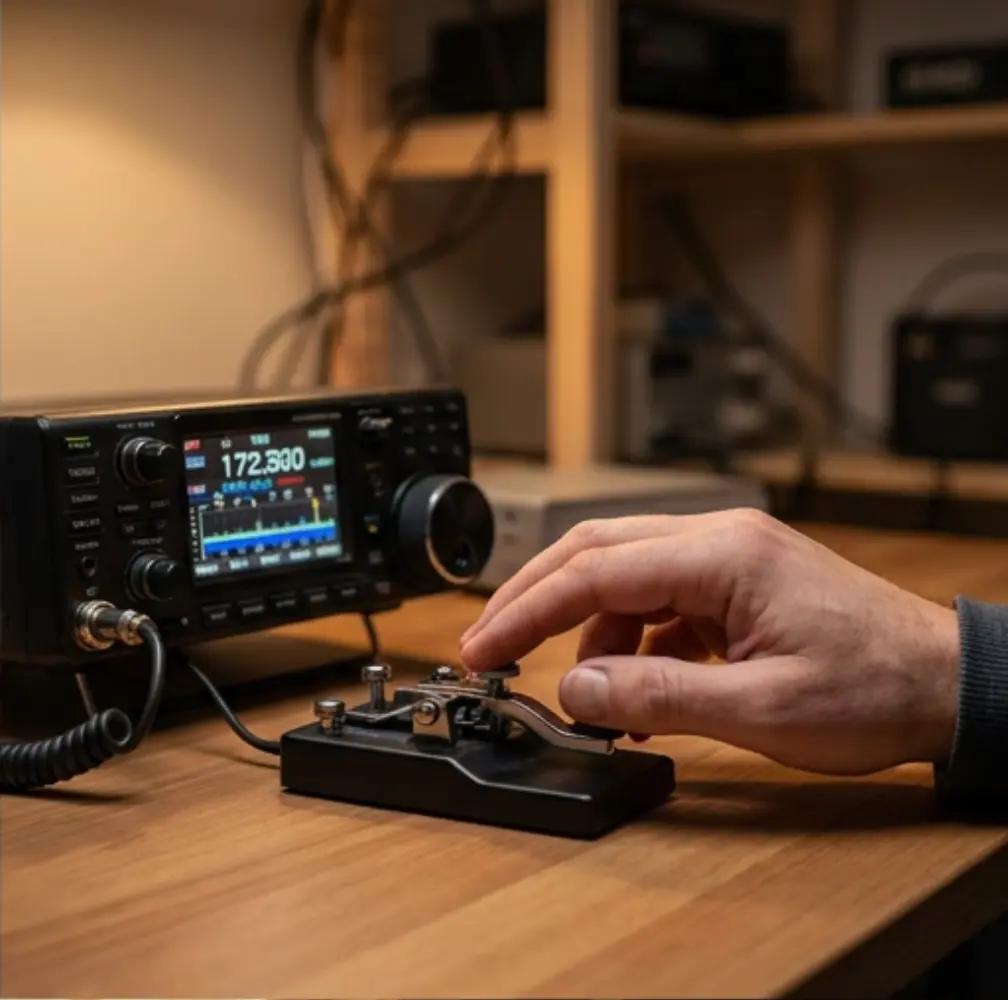
This is the largest living "[morse]" community, end of story. Morse over radio, otherwise known as Continuous Wave (CW) operation, is still a mode being used on the air and many operators prefer it to voice.
Here is why humans have not abandoned it: CW signals penetrate interference and weak signal conditions better than voice signals. Because a CW signal requires less bandwidth and can be heard when there is much less power involved, that makes an absolutely enormous difference when it comes to having a conversation over long distances on low-power equipment. For the same reason oper-ators pursuing DX (long-distance contact) records turn to CW in particular: it gets through when SSB voice mode becomes static.
Some ham operators can copy Morse code in their head at 30+ words per minute without writing anything down, a skill that takes years to build but never really goes away once it's there.
2. Aviation Navigation Aids
This one surprises people. Even in glass cockpit equipped aircraft, VOR (VHF Omnidirectional Range) stations and NDB (Non-Directional Beacons) still identify using a short Morse code identifier.
The reasoning is simple redundancy. GPS can fail, be jammed, or lose signal integrity. For example, when a pilot receives a Morse identifier after tuning to a navigation beacon, it confirms that they have locked on to the correct station. Aviation authorities continue to keep this verification layer because it provides an independent identification method.
3. Maritime Emergency Backup
Commercial shipping transitioned to GMDSS (Global Maritime Distress and Safety System) decades ago, so Morse code is no longer the primary communication method at sea.
However, visual Morse signaling via signal lamps remains a backup method for short-range communication between vessels when radio silence or equipment failures occur. Signal lamps require no satellite connections or complex infrastructure — a reliable capability to have in an emergency.
4. Search and Rescue, Survival Situations
SOS: If you are stuck with no alternative, three short signals, three long signals, and three short signals remains the easiest distress configuration in the world. You don't need a common language, an operable telephone, or cellular coverage. It can be carried by a mirror flash, a whistle pattern, or a flashlight blink.
This is why search and rescue training programs still teach SOS: its universality makes it one of the most reliable emergency signals in existence.
5. Assistive and Accessibility Technology
This is a slightly more obscure modern use. Morse code is used by people with severe motor impairments as an input method for computers and communication devices, using a single switch that inputs dots or dashes into software that converts them into text.
Single-switch input principles have existed in accessibility technology for decades, and Morse-based software continues to be actively developed today because it requires only a single point of physical control.
6. Military and Signals Training
Modern militaries no longer conduct routine operations over Morse code, but some signals and cryptographic training programs around the world still cover it. The value is not operational; it is foundational. The focus is mainly on historical knowledge, communication fundamentals, and signal theory.
Where Morse Code Has Genuinely Faded Out
To be fair and accurate here, plenty of its old jobs are gone for good:
| Former Use | What Replaced It | Why |
|---|---|---|
| Commercial ship-to-shore messaging | Satellite communication (GMDSS, Inmarsat) | Faster, more reliable, carries more data |
| Telegraph networks | Telephone, internet | Real-time voice/text beats sequential tapping |
| Military field communication | Encrypted digital radio | Speed and security requirements outgrew it |
| Railway dispatch signaling | Digital rail control systems | Automation removed the human relay step |
International commercial Morse requirements for ships were formally phased out by the early 1990s in most of the world. That's the clearest marker of its decline as a mainstream communication tool, but decline isn't the same as extinction, and that distinction matters.
Why Morse Code Refuses to Disappear Completely
It works with almost nothing. No appliance, no signal, no exception beyond a torch. Which is a value in and of itself as a backup layer across aviation, maritime and emergency contexts where "what if the main system fails" is an actual planning consideration.
It is a skill, not a device. It is nothing to charge, update, or lose once somebody learns it. And that durability is precisely why it endures in use with hobbyists and preppers who sustain it outside of any sort of official requirement.
It has cultural weight. SOS has penetrated much further than radio circles: it's in movies, it's in survival guides, to say nothing of the general public education. Simply that acknowledgment is what prevents it from disappearing completely.
Morse code is often associated with a telegraph key or ham radio as the way of using Morse code. In fact, it can be anything transmitting an on/off signal, a light, a sound, vibration or even taps on a wall. And that is precisely the purpose of the system.
Should You Bother Learning It in 2026?
If you like ham radio, yes. CW is an active mode, one that is still highly regarded and opens the door to contacts often not possible at all and certainly not reliably with voice modes. If you have an inclination to be a bit more prepared in the event that something goes wrong, learning SOS and a handful of core letters is well worth knowing anyway, so it takes little or no time. You can find it a hilarious ability with actual history behind it, even if you'll never need to use it operationally, which is great if you're just curious.
Start with just the letters in SOS and your own name. Building fluency in Morse is far easier when you learn it in small, functional chunks instead of memorizing the whole alphabet at once.
The Bottom Line
Morse code was no longer necessary decades ago, but it never became obsolete. It lives on as a backup system, a skill for hobbyists and makers, and an accessibility tool, quietly performing tasks that don't need to be fast, just reliable. That is a remarkable sort of longevity for a method of communication devised in the 1830s, and it's precisely why the question "is Morse code still used?" keeps coming up. The short answer is that while its scope is smaller than it used to be, it is by no means obsolete.
Try our interactive Morse Code Translator & Trainer tools directly in your browser. Practice ear-training, generate audio tones, or decode Morse.
Ready to practice? Try our new global translator on morsecode world to decode cod morse instantly.
Frequently Asked Questions
Q:Is Morse code still used today?
Yes. It is used for amateur radio (CW mode), as an identifier with aviation navigational beacons, as a maritime emergency backup and in assistive technology. Now it's no longer useful for the mainstream commercial or military communication.
Q:Why is it that the pilots still can hear Morse code in the cockpit?
Although piloting in a modern aircraft is GPS controlled, VOR and NDB navigation beacons continuously transmit a brief Morse identifier to ensure that pilots have tuned into the correct frequency.
Q:Is Morse code still used for emergencies on ships?
Although GMDSS systems which utilise only satellite transfer are now the norm for commercial ships, smaller vessels and mariners without said equipment may still resort to Morse via signal lamp as a last-ditch method of distress.
Q:Is Morse code hard to learn?
Reading at a useful pace requires repeated practice but you can learn letter basics and SOS letters in just a few moments. It usually arrives in weeks to months of regular practice; including real-time listening fluency.
Q:What is SOS?
You know that SOS, the distress signal — Has three dots, three dashes, three dots. No word stands for it. The reason the pattern was selected, is because it is simple, pronounced and easy to identify even in a stressful situation.