International vs. American Morse Code: What's Actually Different (and Which One You Should Learn)
American Morse code and International Morse code aren't the same system. See the real letter differences, why they split, and which one to learn today.
Kalana Sandeep
Creator of Morse Code Translator
Two Codes, One Name
If you had asked people what "Morse code" sounds like, most would have visualized a clean series of short and long beeps: dit-dit-dit — dah-dah-dah — dit-dit-dit. It paints an accurate mental picture, but one that only applies to the first of two systems that have operated over the last two centuries under the name "Morse code".
The version everyone learns today, which powers Morse code apps, amateur radio exams, and modern Morse input tools such as Gboard's Morse keyboard, is technically called International Morse Code. However, it worked in ways that were genuinely different from the original system Samuel Morse and his partner Alfred Vail created in the 1830s and 1840s. Today, the earlier system is usually referred to as American Morse Code, and anyone reading 19th-century telegraph logs using modern Morse knowledge will find letter patterns that look entirely unfamiliar.
For anyone researching telegraph history, restoring old gear or trying to figure out why "Morse code" sometimes seems to come in more than one version you might want to know how these two systems separated, and which still differ.
Want to test the historical patterns directly? Try the American Morse Code Translator.
Why One Code Became Two
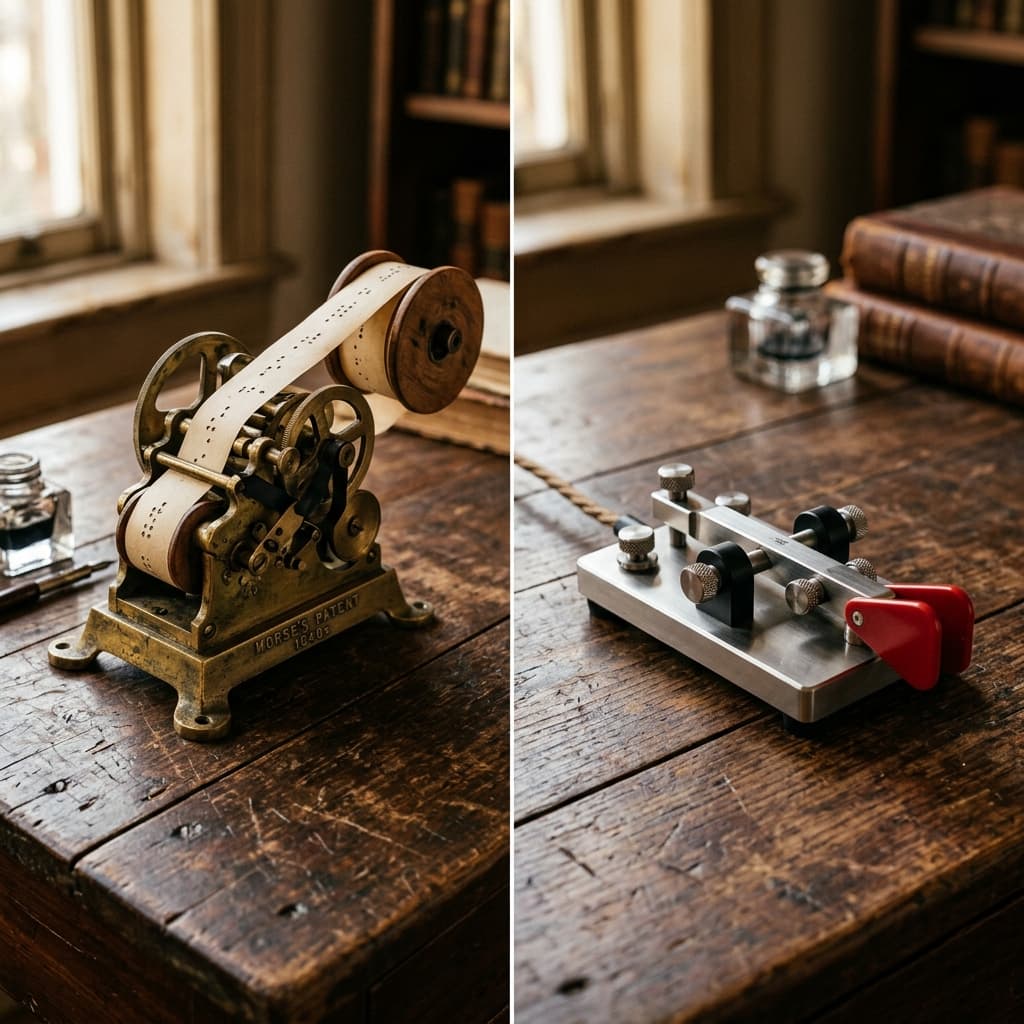
Morse and Vail didn't design it for radio. They designed it for a paper-tape recorder, or register, which was a mechanical device that punched dots and dashes into a rolling strip of paper. That hardware influenced the code in ways that were logical at the time, but created issues later on.
Unlike phonetic languages, early telegraphy did not depend on sound but was based solely on paper marks. As Morse and Vail added shortcuts that worked mechanically, they created significant problems once operators learned to read Morse by ear instead of by sight. Some letters used an internal pause built directly into the character itself. Others used an elongated dash, about twice the standard length. Moreover, in the earliest version of the code, there wasn't even a character for zero.
In original American Morse, the letter "O" consists of two dots with a small internal pause between them, containing no dashes at all. To someone trained only on International Morse, American Morse "O" sounds like two separate "E"s rather than a single letter.
In the late 1840s, German engineer Friedrich Clemens Gerke redesigned the system to make it logical for international and radio communications. He eliminated internal pauses and long dashes, rebuilding every letter as a simple sequence of standard-length dots and dashes. The Gerke revision was adopted by the International Telegraph Convention in Paris in 1865 and later evolved into the International Morse standard. As this newer standard spread globally, the original Morse and Vail system became known as American Morse Code, since it remained dominant in U.S. landline and railroad telegraphy for decades afterward.
The Structural Differences That Actually Matter
Three features separate the two systems at a fundamental level, and all three explain why American Morse never fully caught on outside North America.
Variable Dash Lengths
Dash length in International Morse is always exactly three times the dot duration. American Morse, by contrast, included a second, longer dash roughly double the standard length, reserved for specific characters. For instance, American Morse represented the letter L with a single long dash, while zero was sent as a pair of long dashes. Because International Morse maintains a single, uniform dash length, timing remains unambiguous regardless of transmission speed.
Internal Character Spacing
This is the most confusing difference out there and this will be discussed here. In International Morse, only those pauses between separate letters and words matter; there is never a gap hidden within one letter. American Morse violates this principle for a handful of letters by encoding a small internal pause directly into the symbol.
If you listen closely, this internal spacing is also what makes American Morse much harder to copy by ear than it would be on a physical paper-tape recorder, notably over radio — where timing is already less easy to judge as precisely. An insistently extended pause embedded in a letter could be interpreted as an interstitial pause between two characters, splitting one into two.
Number Patterns
International Morse numbers follow a clean, predictable sequence: 1 is .----, 2 is ..---, 3 is ...--, 4 is ....-, 5 is ....., 6 is -...., 7 is --..., 8 is ---.., 9 is ----., and 0 is -----. American Morse never adopted this clean logic, and a few of its numbers used the same long dash as alphabetical characters, making them harder to memorize and easier to mishear over radio.
Letter-by-Letter: Where the Two Codes Genuinely Diverge
Of the 26 letters in the alphabet, ten have codes that differ enough between the two systems to cause real confusion if you mix them up. Here's exactly how they compare.
| Letter | International Morse | American Morse | What's Different |
|---|---|---|---|
| C | dash-dot-dash-dot | dot-dot [pause] dot | American version has a built-in pause splitting the letter in two |
| F | dot-dot-dash-dot | dot-dash-dot | Completely different symbol sequence, not just spacing |
| J | dot-dash-dash-dash | dash-dot-dash-dot | Unrelated patterns; easy to confuse with other letters if you know only one system |
| L | dot-dash-dot-dot | one long dash | American Morse reduces L to a single elongated dash |
| O | dash-dash-dash | dot [pause] dot | American O sounds almost nothing like International O |
| P | dot-dash-dash-dot | five dots in a row | American P is unusually long and easy to miscount |
| R | dot-dash-dot | dot [pause] dot-dot | Another letter split by an internal pause in American Morse |
| X | dash-dot-dot-dash | dot-dash-dot-dot | Reordered pattern between the two systems |
| Y | dash-dot-dash-dash | dot-dot [pause] dot-dot | American Y relies on the internal-pause trick again |
| Z | dash-dash-dot-dot | dot-dot-dot [pause] dot | Four elements split by a pause rather than sent as one continuous run |
Many people think that American Morse is just International Morse with a few letters thrown in. It is not that simple. Most of these differences are not just cosmetic reshuffles: they are based on a completely different set of rules concerning where to place pauses and how long the dashes should be, which were intentionally eliminated in International Morse.
Was American Morse Actually Worse?
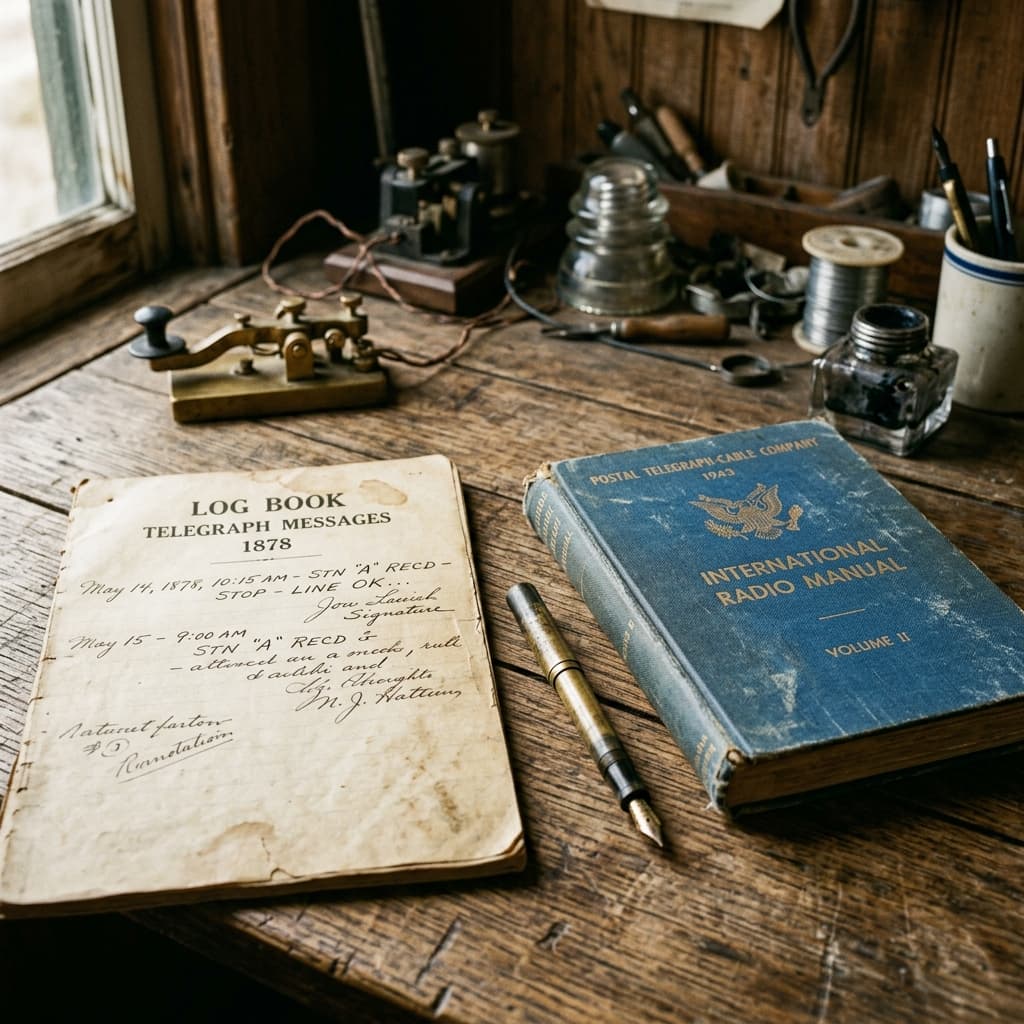
American Morse was designed for a specific device — the mechanical paper-tape register — and it worked remarkably well with that hardware. Competent operators using American Morse could deliver over 40 words per minute on landline telegraph systems, making it highly efficient for paper-based recording.
It was not that American Morse was badly designed; rather, international communications required a single, uniform standard. As telegraph cables crossed international borders and radio communications replaced paper tape, reading Morse by ear made internal pauses and variable dash lengths a major obstacle. A system without internal timing traps proved far superior for audio-based copying, and International Morse was designed for that exact purpose.
Which One Should You Actually Learn?
If you want to learn Morse code today for ham radio, emergency signaling, or visual accessibility tools, International Morse Code is the clear choice.
It is the universal standard used by amateur radio operators worldwide, recognized by the ITU, and built into modern software, trainer apps, and accessibility tools. Its consistent timing rules make it significantly easier to learn and master, as learners do not have to contend with internal character pauses.
There are rare cases where American Morse is worth learning, such as if you are looking at 19th-century U.S. telegraph history or restoring/exercising older landline equipment with American Morse or directly working with pre-1865 telegraph records. There are a couple small railroad telegraph museums, as well as individual dedicated hobbyists in the U.S. who still carry on the craft, but for more ordinary communication it is an historical niche rather than useful skill.
If someone is learning Morse code today, International Morse Code is the version to learn because it is the universal standard used worldwide. Both systems earned their place in telegraph history, but International Morse remains the living language of dots and dashes.
Our online translator is powered by official ITU International Morse Code standards. Convert text to dots and dashes with real-time sound playback.
Frequently Asked Questions
Q:What is the difference between American and International Morse code?
American Morse code has two kinds of dashes that are variable length and also incorporates short pauses as part of certain letters, but International Morse only uses one dash length and never puts a pause within a single character. That structural difference is what makes International Morse orders of magnitude more simple to copy accurately by ear, and especially over the air.
Q:Why International Morse was dropped in favour of Amateur Morse?
American Morse was intended for a mechanical paper-tape recorder, and its internal pauses and variable dash length did not interfere with operation on such equipment. When intruding on telegraph networks and radio brought sound reproduction to the masses, those attributes became a liability; timing is so much harder to judge by ear than by physical tape. Boosted by a steady stream of new information — Barber persuaded the other members of International Morse not to make any official changes, fixing that problem; it has been standardized since 1865.
Q:Does anyone still use American Morse code anywhere today?
Today it is of primarily historical interest. One encounters this with studies of 19th Century U.S. telegraphy, working on or restoring historical landline telegraph gear, and in pre-1865 records work. Moreover, very few railroad telegraph museums and amateur American-Morse enthusiasts maintain the code in practice, but it isn't used for contemporary communication.
Q:Which letters are most different in the two Morse systems?
C, F, J, L, O, P R X Y and Z all have semantically different codes in the two systems. Some of them, such as C, 0, R, Y and Z, depend on an internal pause within the character in American Morse (this is a feature that International Morse completely removed).
Q:Should beginners learn American Morse code or International Morse code?
Most practical uses require mastering international Morse code. It is the worldwide standard for ham radio, the version needed for ITU-related traffic, and the system upon which all contemporary Morse code apps and accessibility tools are constructed. American Morse should only be learned for historical research or antique equipment work.