How to Say "I Love You" in Morse Code (With Sound, Flashlight, and Text Examples)
Learn how to say "I love you" in Morse code: the exact dot-dash pattern, how to tap or flash it, and why it's one of the easiest phrases to learn.
Kalana Sandeep
Creator of Morse Code Translator

A Three-Word Phrase That's Older Than Texting
Long before anyone typed a heart emoji, telegraph operators sent messages by tapping out each letter by hand, carefully ensuring that the person on the other end understood the message. Slower than a modern text, Morse code requires intent and effort — which is precisely why sending a secret message in dots and dashes feels far more personal than typing an automated text.
The good news is that you only need a basic understanding of Morse code, a way to send signals, and some practice. "I love you" is actually one of the easiest phrases to learn in Morse code, as it relies on several of the simplest letter patterns in the entire alphabet.
The Full Pattern
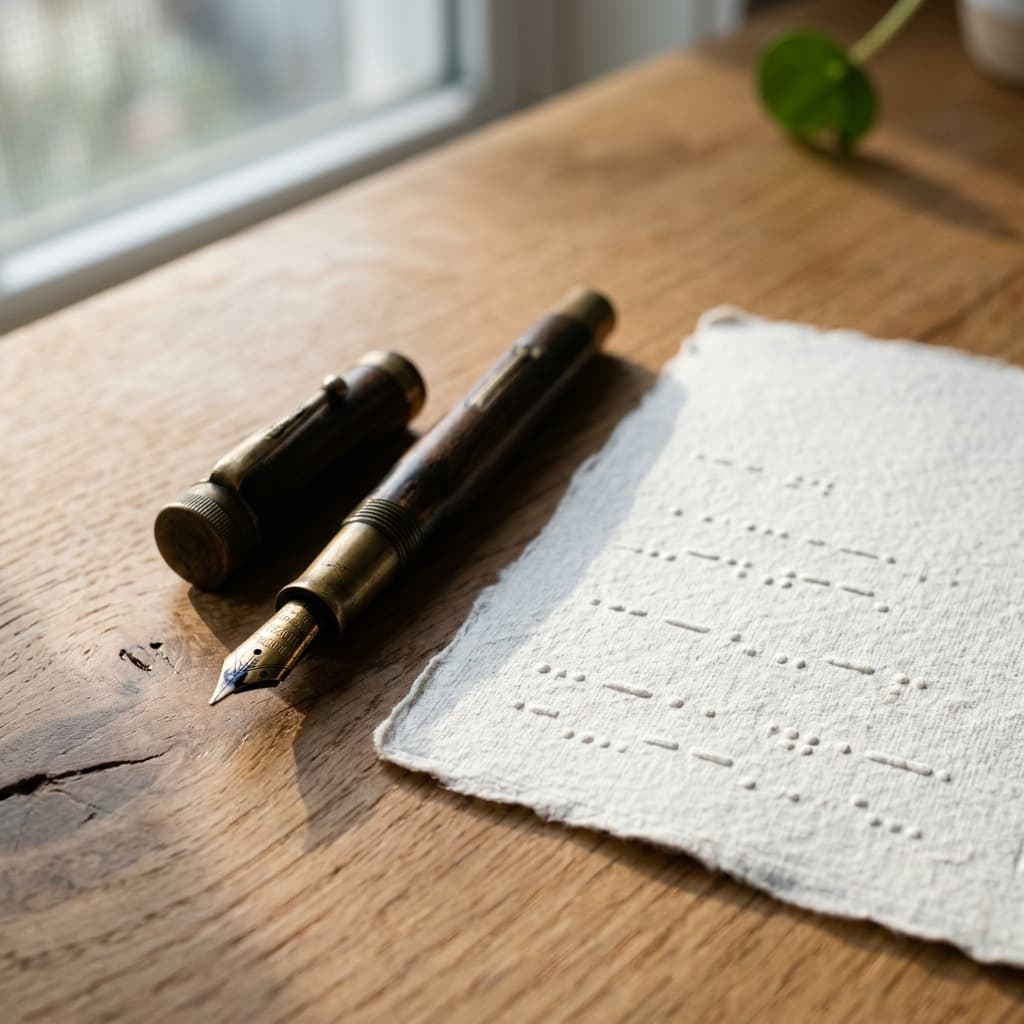
In International Morse code, "I love you" breaks down into eight letters across three words. Here's the complete sequence, with word breaks marked clearly:
If you're new to reading that notation, a single dot is a short tap or flash, a dash is roughly three times longer, and the slash marks show where one word ends and the next begins.
Breaking Down Each Letter
It's easier to hold onto this phrase if you understand what each letter is doing individually, rather than memorizing the whole string as one long blur of symbols.
| Letter | Pattern | Sounds Like |
|---|---|---|
| I | · · | dit-dit |
| L | · − · · | dit-dah-dit-dit |
| O | − − − | dah-dah-dah |
| V | · · · − | dit-dit-dit-dah |
| E | · | dit |
| Y | − · − − | dah-dit-dah-dah |
| O | − − − | dah-dah-dah |
| U | · · − | dit-dit-dah |
The letter "O" (dah-dah-dah) appears twice in this phrase — once in LOVE and once in YOU. Because "O" repeats, you only need to learn seven unique letter patterns (I, L, O, V, E, Y, U) to spell out all eight letters.
Why This Phrase Is Genuinely Easy to Learn
Morse code has a reputation for being difficult, primarily because people assume they have to memorize all 26 letters at once. However, you don't need the entire alphabet to send this message. While the phrase contains eight total letters, you only need to learn seven unique character patterns (I, L, O, V, E, Y, and U).
"I" is simply two dots (··), while "E" is a single dot (·) — the shortest symbol in the alphabet. Together, these two letters make up a quarter of the entire phrase. "V" (···−) features a famous four-beat rhythm (dit-dit-dit-dah). During World War II, this pattern became associated with the Allied "V for Victory" campaign because its rhythm matches the opening phrase of Beethoven's Fifth Symphony.
Don't try to memorize the dots and dashes as symbols on a page. Say the rhythm out loud instead. "Dit-dit" for I, "dah-dah-dah" for O, "dit" for E. Your ear will pick up the pattern faster than your eyes will.
How to Actually Say It Out Loud
Morse operators don't spell out letter names when they're sending or receiving code. They speak, or hear, the rhythm directly. Here's how the full phrase sounds when you say it the way an operator would:
- I: "dit-dit"
- LOVE: "dit-dah-dit-dit, dah-dah-dah, dit-dit-dit-dah, dit"
- YOU: "dah-dit-dah-dah, dah-dah-dah, dit-dit-dah"
So a nice, consistent, even pace as you go. Speed really isn't all that important here, as you're not attempting to set a record or take an amateur radio exam. The important thing is that you sustain a consistent pace, so your dot always sounds like a dot and your dash always sounds fractionally longer, no matter how little you are travelling.
Sending It With a Flashlight or Your Phone
Visual Morse works on the exact same timing rules as audio Morse, replacing sound pulses with flashes of light:
- A dot equals 1 unit of time (a quick flash)
- A dash equals 3 units of time (a longer flash, held three times as long as a dot)
- Leave a 1-unit pause of darkness between elements within the same letter
- Leave a 3-unit pause of darkness between individual letters
- Leave a 7-unit pause of darkness between words ("I", "LOVE", and "YOU")
A flashlight works well for this, but your phone screen does the job just as easily. Tap the screen on and off to flash it, or if you'd rather keep things quieter, most Morse code apps and translator tools include a built-in torch or flash mode that handles the timing automatically.
Timing consistency is essential. If your dots and dashes bleed together, your recipient won't be able to distinguish between short and long signals. Slow and steady timing beats fast and sloppy signaling every time.

Creative Ways People Actually Use This
Once you've got the pattern down, there's no shortage of ways to work it into something personal:
- Jewelry or engravings: the dot-dash sequence engraved on the inside of a ring or a bracelet clasp
- Greeting cards: writing out the pattern by hand alongside (or instead of) the plain English words
- Tattoos: turning the secret message into minimalist geometric ink using a morse code tattoo generator
- Text messages: sending the phrase as a pattern of short and long vibration pulses instead of typing it out
- A car horn or metal railing: literally tapping the rhythm out, the same way telegraph operators once did
- A private signal between two people: using it as a code phrase only you and one other person recognize, whether that's a wedding vow reference or a running joke
None of these require any special equipment. The whole appeal of Morse code is that it was designed to work with almost nothing, a wire, a light, a sound, or a tap is all it ever needed.
Use our free Morse Code Translator to play audio playback, download WAV audio, or flash the pattern with light directly in your browser.
Frequently Asked Questions
Q:How do you say "I love you" in Morse code?
The complete Morse code sequence is .. / .-.. --- ...- . / -.-- --- ..- . Spoken aloud by an operator, it sounds like: I ("dit-dit"), LOVE ("dit-dah-dit-dit dah-dah-dah dit-dit-dit-dah dit"), and YOU ("dah-dit-dah-dah dah-dah-dah dit-dit-dah").
Q:Is "I love you" hard to learn in Morse code?
No, it is one of the easiest phrases to learn. Although it contains eight total letters across three words, the letter O repeats, meaning you only need to learn seven unique letter patterns. Simple characters like I (..) and E (.) make up a quarter of the message.
Q:How do you signal "I love you" with a flashlight?
Use a short flash (1 unit) for dots and a long flash (3 units) for dashes. Leave a 1-unit pause between flashes within a letter, a 3-unit pause between letters, and a 7-unit pause between words.
Q:Why do you only need seven unique letter patterns for "I love you"?
The letter O (---) appears twice in the phrase—once in LOVE and once in YOU. Because O is repeated, you only need to learn I, L, O, V, E, Y, and U to spell all eight letters.
Q:What is the historical significance of the letter V in Morse code?
The letter V (...-) features a distinct rhythm of three dots and a dash. During World War II, this pattern was adopted for the Allied "V for Victory" campaign because its rhythm matches the famous opening motif of Beethoven's Fifth Symphony.