How to Signal "HELP" in Morse Code (And When to Use It Instead of SOS)
Learn how to send "HELP" in Morse code with light, sound, or touch, when it makes more sense than SOS, and how to practice it until it's second nature.
Kalana Sandeep
Creator of Morse Code Translator
How to Signal "HELP" in Morse Code
While SOS is the most famous distress signal, knowing how to send "HELP" in Morse code is also valuable because it communicates a clear, literal message. SOS is a universal distress signal used to indicate an emergency situation. HELP directly communicates that you need assistance at this moment, serving a more specific purpose.
A Full Breakdown of How to Send It, Why It's Built the Way It Is, and When You'd Actually Grab For It Over the Famous Distress Call:
Breaking Down Each Letter
Morse code builds words letter by letter, and every letter has its own fixed rhythm of short and long signals (dots and dashes). Here's what makes up HELP:
| Letter | Pattern | How It Sounds |
|---|---|---|
| H | · · · · | dit-dit-dit-dit |
| E | · | dit |
| L | · − · · | dit-dah-dit-dit |
| P | · − − · | dit-dah-dah-dit |
Put together, HELP looks like this:
So, if you count the individual signals, you will get thirteen in total – four for H, one for E, four for L and four for P, which is more than SOS (9 in total). But it is a reasonable trade-off: HELP is an actual word you can read, not an abstract warning.
It is always better to speak it out before sending. It sounds strange the first few times — "dit dit dit dit, dit, dit dah dit dit, dit dah dah dit" — but if you repeat it out loud, it locks into memory faster than staring at dots and dashes on a sheet of music paper.
HELP or SOS? How to Pick
These two are easily confused with each other, and many people assume they are one and the same. They serve different purposes.
SOS is a universal distress signal used to indicate an emergency situation. It doesn't actually mean anything (the "save our souls" phrase was a mnemonic invention added afterward), and its main advantage is that anyone, trained or untrained, instantly recognizes the three-dot, three-dash, three-dot pattern. Use it when you want the fastest and most universally understood Morse distress signal, particularly when communicating with someone without Morse knowledge.
HELP makes more sense when:
- Since you are talking to someone who already understands Morse code, a particular word conveys more meaning than just a general alert.
- You are doing drills and you want to develop authentic letter reading ability instead of just memorizing one specific model.
- Using Morse in non-emergency situation like a game, jewelry, or secret message between friends
Sending HELP to someone who doesn't know Morse code and is not going to recognize it like one recognizes SOS. HELP with an actual alphabet receiver is nothing but noise. It is this S-most pattern that makes SOS work, and the reason SOS works in part is because its S-Morse has some unique recognition value (at least after a while) even outside of Morse people.
Sending HELP with Sound
This is the most common method, and it works with almost anything that can make two distinct sounds, short and long.
- A short tap, beep, or knock is your dot.
- A longer tap, beep, or knock (roughly three times the length) is your dash.
- Leave a small gap between each letter so the person listening can tell where one ends and the next begins.
You can tap this out on a table, a metal railing, a car horn, or a whistle. If you're using a radio or an app with a tone generator, keep your rhythm steady rather than fast. A clean, consistent pace is far easier to decode than a rushed one.
Sending HELP with Light
Visual signaling works particularly well at night or across distances where sound won't carry, think open water, mountainsides, or foggy conditions.
- A short flash is a dot.
- A longer flash (held about three times as long) is a dash.
- A brief pause separates each letter.
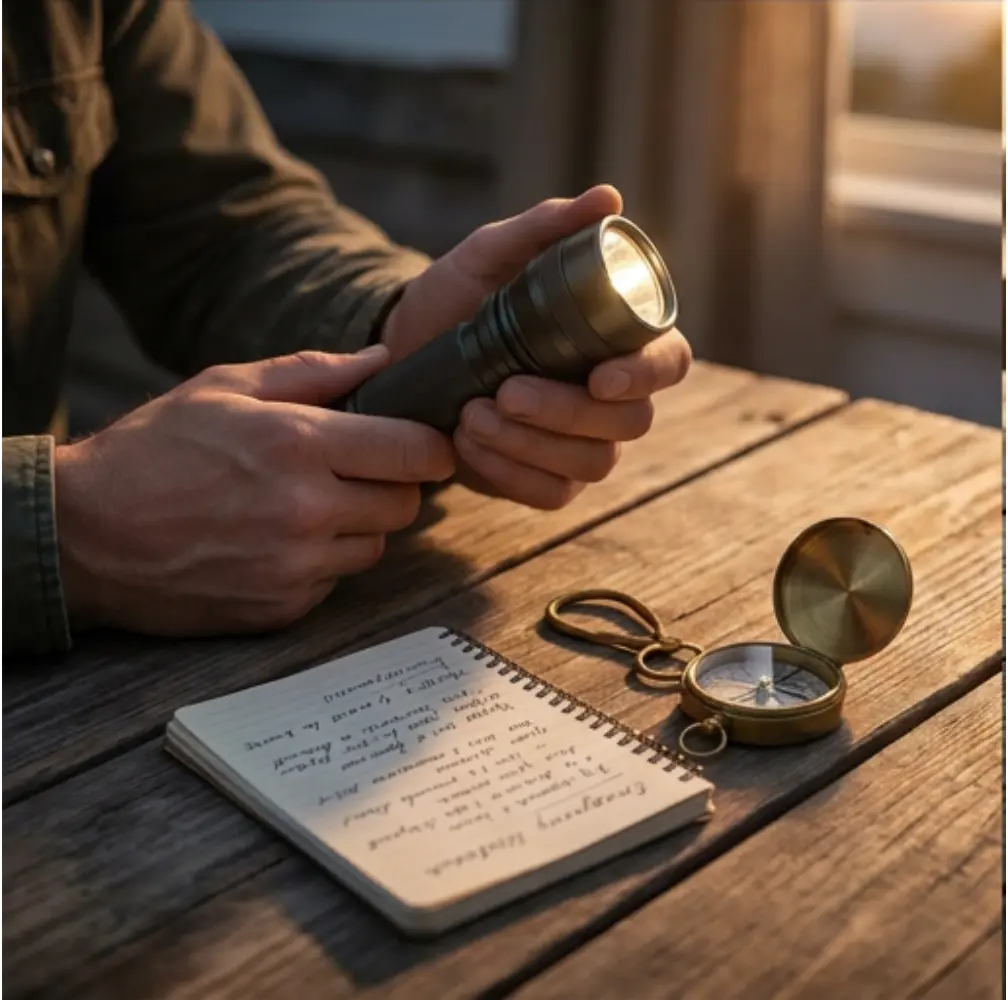
A flashlight, a phone's camera flash, or even sunlight bounced off a mirror can all carry this signal. The technique that search and rescue trainers often teach for improvised light signaling is to count in your head, "one" for a dot, "one-two-three" for a dash, so your timing stays consistent even under stress.
Sending HELP Without Sound or Light
If neither option is available, Morse does not cease to work; it changes its medium.
- Blink: a series of fast blinks for dots and longer held blinks for dashes. Morse has also been adapted as a communication method when traditional speech is difficult or unavailable.
- Taps with hand or foot: useful when tied up, injured or need to keep it quiet.
- Tones and pauses: if you can write but not say them, the dots and dashes we are after can also be sketched out in dirt, snowfall, condensation on a window or paper.
And that's the thing about Morse code: The tool was never really it. It is the pattern. It could carry anything that has two states – on or off, short or long.
A Note on Timing
Morse code has a formal timing standard, and getting it roughly right is what separates a readable signal from a confusing one:
- A dot lasts one unit.
- A dash lasts three units.
- The gap between dots and dashes inside the same letter is one unit.
- The gap between separate letters is three units.
- The gap between separate words is seven units.
You don't need a stopwatch for casual practice, but keeping dashes noticeably longer than dots, and pausing a bit longer between letters than within them, makes a huge difference in how easy your signal is to read.
Practicing HELP as a Beginner Word
If you are a Morse code beginner and looking for a good word to start with, HELP is indeed just that — as it combines simple: (E) letters with longer, more complex characters (L, P), so the single-word will give you 2 different rhythm patterns in one instead of repeating the same short length pattern over and over again!
So, a simple way to develop the ability:
- Initially take training on H, E, L and P separately. Repeat each pattern until it feels as automatic as breathing.
- Slowly send the entire word, it is better to minimize errors than have speed. Speed comes later.
- Send it; have someone else tap or flash it at you and record what you hear or observe.
- When you get comfortable with HELP, try replacing letters or adding them (HELLO and HI because they are composed of some letters that were already learned).
Morse code translators (which are online tools that convert what you type into dots and dashes) are a genuinely useful method to verify yourself before sending signals. Type "HELP" into the translator and compare it against what you send by hand.
Limitations Worth Knowing
Morse code is not a miracle; it is important to understand its limitations. Sent too fast or without a constant pace, it becomes indecipherable even for an experienced operator. It also assumes the receiver knows Morse code, which is why SOS remains the safer default in an emergency to an unknown audience. Although HELP is a real, decodable word, it takes longer to transmit than SOS — acceptable if your signal is clear, but potentially critical if time is limited.
Wrapping Up
While mastering the ability to send "HELP" in Morse code is not a replacement for official protocols, it is a useful skill for amateur radio enthusiasts and emergency communication practice. This does not mean that SOS will be replaced as the global distress signal, nor is it intended to be. However, as a practical word to augment your real Morse fluency, HELP is hard to beat.
Listen to the exact audio tone pattern for HELP or practice decoding it in real-time with our Morse Code Trainer.
Frequently Asked Questions
Q:How is "HELP" coded by means of Morse code?
This encodes HELP as · · · · (H), · (E), · − · · (L), and then at the end, you have the P: · − − · giving HELP → .... . .-.. .--.
Q:Is "HELP" the same as SOS in Morse code?
No. SOS (· · · − − − · · ·) is not a word, a universal life or death message that does not need to be understood as language at all, only seen as pattern. HELP is a real word, and only makes sense to someone who knows the morse alphabet.
Q:Can you send "HELP" without any equipment?
Yes. You can touch it with your hand or foot, tap it with your eyeball, or scribble the dots and dashes anywhere. It can be any method that gives you a short and long signal.
Q:Why does it take longer to send letters L than E?
This is because Morse code gives shorter patterns to letters that are used more often. E is the most common letter in English, so it received the simplest code: a pure dot. Relatively rare letters like L receive longer patterns.
Q:Should you still learn Morse code today?
Yes, but mainly for amateur radio, aviation navigation identifiers, maritime backup signaling and accessibility aides for people with mobility or speech impairments. It is not a standard means of communication anymore but exists as a solid standby when technology isn't an option.