The History of Morse Code: From a Grieving Painter's Notebook to Modern Ham Radio
The real history of Morse code: why Samuel Morse invented it, how it became a global standard, and why operators still use it today.
Kalana Sandeep
Creator of Morse Code Translator

An Invention Born Out of Grief
Many histories of technology begin with aspiration. This one begins at the typing of a letter too late.
According to the commonly told account, in 1825, Samuel F. B. Morse was in Washington, D.C., working as a portrait painter, when a message arrived informing him that his wife back home in Connecticut was gravely ill. By the time he reached home, she had already been buried because news of her illness had traveled by horse.
That loss deeply affected him. A few years later, during a transatlantic sea crossing in 1832, Morse conversed with Charles Thomas Jackson, a scientist experimenting with electromagnetism. A realization struck Morse: if electrical impulses could travel instantaneously along a wire, news could as well, preventing families from learning about urgent news days after the fact.
By 1836, Morse had outlined a rudimentary system using electrical dots and dashes sent over wires to convey letters and numbers.
Solving a Problem That Doesn't Exist Anymore
Communication in the early 1800s was severely constrained. With no telephone, national telegraph network, or radio, messages between major cities traveled only as fast as a horse or sailing ship. News, commodity prices, and family emergencies moved at a pace that people today would consider unbearably slow.
While Morse was not the only inventor pursuing electrical communication, he possessed two key advantages: personal determination and the commitment to refine the invention for nearly a decade.
Morse's original concept wasn't built around letters at all. He initially imagined a numbered code, where each number corresponded to a word in a special dictionary, essentially a lookup table sent over wire. It was clever, but clumsy in practice.
The Code Gets Its Letters
Morse code as most people think of it today did not come entirely from Morse himself. His business associate, a machinist named Alfred Vail, has been credited for changing from a numbers-and-dictionary system to the direct letter-by-letter alphabet. The hardware that had ultimately made it possible to send, and read the code was also better: Vail made changes to the mechanical key and receiver.
They publicly demonstrated their telegraph system in 1838. While it worked well in early tests, it took several more years to secure government funding and expand the system.
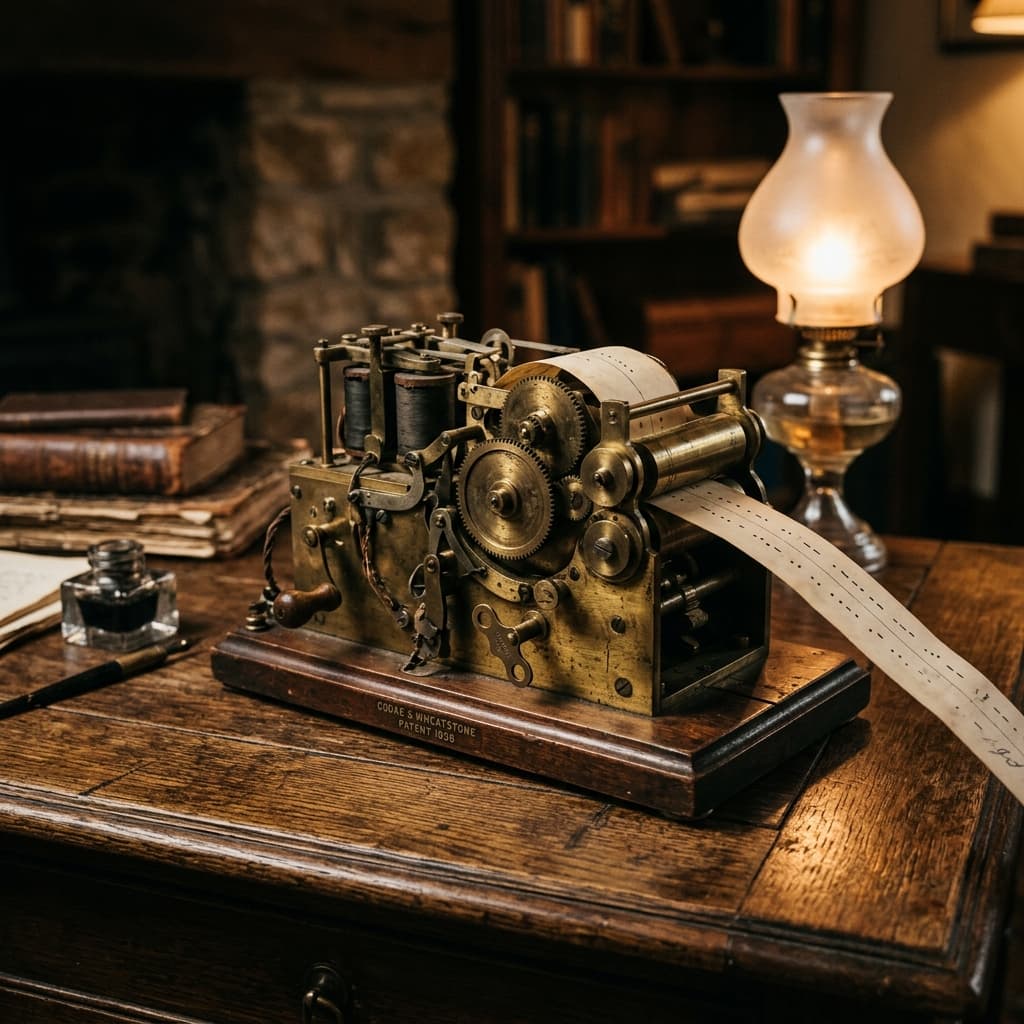
On May 24, 1844, Morse transmitted the first official long-distance message from the U.S. Capitol in Washington to a railroad station in Baltimore. The historic line — "What hath God wrought" — marked the dawn of real-time telecommunications.
Why the Code Had to Change
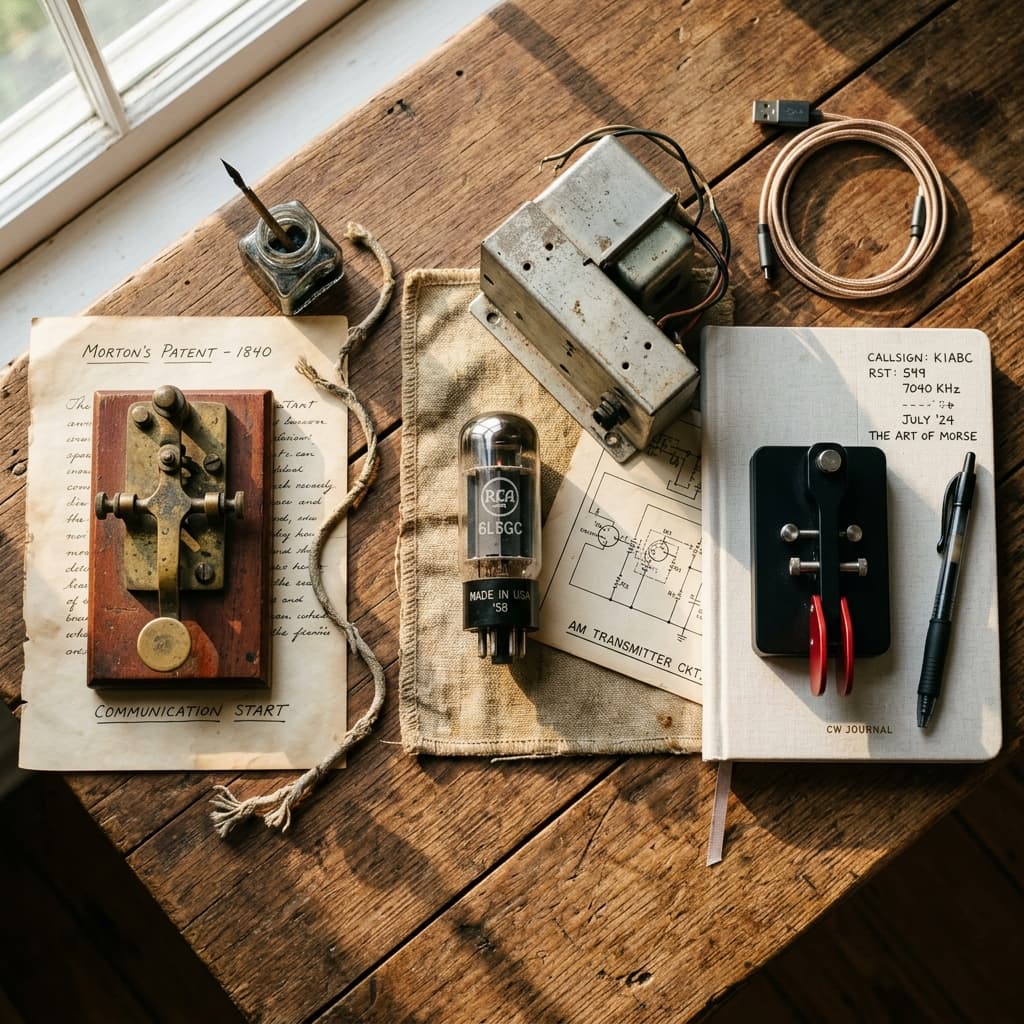
Though American Morse Code worked just fine within a country, it had a flaw that became apparent as telegraph lines crossed international borders: some characters in the code (such as the T and O) relied on spacing and timing patterns that were difficult if not impossible to standardize across different equipment and operators and prone to error.
In 1848 a German engineer called Friedrich Clemens Gerke redesigned the system, which included making the characters more consistent and cutting down on timing rules. It was standardised internationally in 1865 based on his version. This revision came to be known as International Morse Code, and with only a few minor changes still remains the version found in use today all around the world by amateur radio operators.
People sometimes assume "Morse code" is a single, unchanged system dating back to 1836. It isn't. What most modern learners study is Gerke's refined international version, not Morse and Vail's original American code. The two are related but not identical, and if you ever try to read historic American telegraph logs using modern Morse knowledge, some characters won't match.
Proving the Idea Could Cross an Ocean
Telegraph lines expanded rapidly across Europe and North America by the 1850s, but bridging the ocean remained an immense challenge. Laying a transatlantic cable was one of the grandest engineering feats of the 19th century.
The first-ever message sent across the Atlantic — a congratulatory note from Queen Victoria to President Buchanan in 1858 — took about sixteen hours to transmit. Although that initial cable failed a few weeks later, it proved that the theory behind transatlantic electrical communication was possible. A permanent, reliable cable was laid in 1866, making international communication near-instantaneous.
SOS and the Sinking That Made It Famous
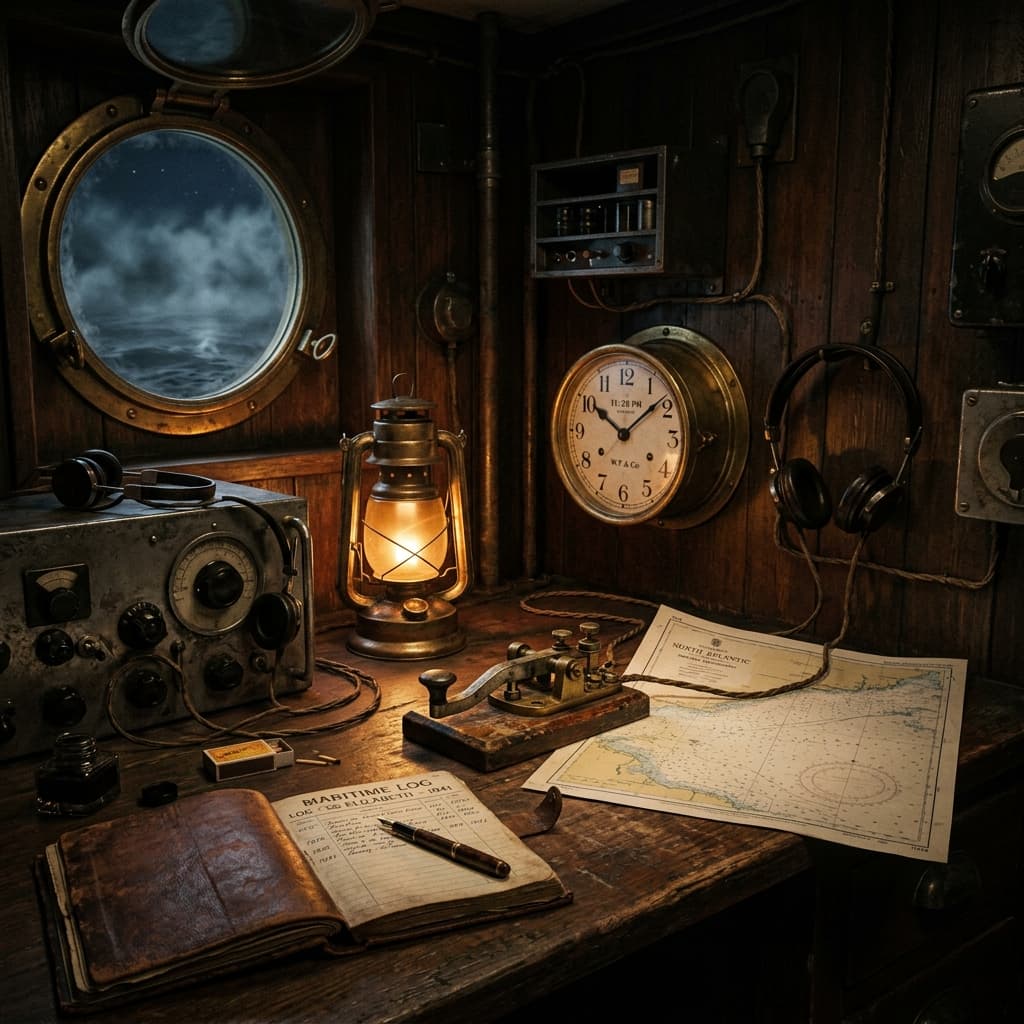
SOS was not originally created specifically for naval distress, although it later became strongly associated with maritime emergencies. The pattern (three dots, three dashes, three dots) was established at the International Wireless Telegraph Convention in Berlin in 1906. The rhythm was chosen because it was distinctive, symmetrical, and easily recognizable through radio static and interference.
The general public became widely familiar with the signal six years later during the Titanic disaster in 1912, when wireless distress calls captured global attention and proved the critical importance of radio telegraphy at sea.
Two World Wars Fought Partly in Dots and Dashes
Morse code was heavily used for military coordination in both World Wars. Trained operators could send and receive at 20 to 30 words per minute over long distances. Morse was valued because it could travel over long distances using weaker signals and less bandwidth than voice transmissions.
The famous World War II German Enigma machine didn't supplant Morse code—it relied upon it. And while Enigma jumbled things up into ciphertext, that ciphertext still had to be sent over the air — and it went out in ordinary Morse.
Radio Set Morse Code Free From Wires
Morse code entered a new era in the 1890s when Guglielmo Marconi developed practical wireless telegraphy. Transmissions no longer required physical wires connecting two points. Early radio was essentially wireless Morse — sending dots and dashes through the electromagnetic spectrum.
This capability proved vital for maritime navigation and aviation. Morse signals could penetrate heavy atmospheric noise and weak signal conditions where voice communication would fail entirely.
Retirement From Official Duty
Eventually, digital systems outpaced Morse for professional and commercial use. In 1999, the Global Maritime Distress and Safety System, known as GMDSS, formally replaced Morse code as the standard for maritime distress communication. And in 2003, the International Telecommunication Union removed the Morse code proficiency requirement for amateur radio licenses worldwide, closing the book on Morse as a mandatory professional skill.
Don't mistake "no longer required" for "no longer used." Plenty of hobbyists assume Morse code quietly died out once licensing requirements dropped. It didn't. It just stopped being mandatory and started being a choice.
Why Morse Code Refused to Disappear
Strangely enough, dropping that requirement does not remove the skill and arguably makes it even more enticing to the people still using it. In fact, an estimated 750,000 licensed amateur radio operators around the U.S. still actively communicate using Morse (often referred to by its technical category, CW—for continuous wave)—not because they have to but because it does things that voice communication can't do well (or at all). When a voice transmission in the same conditions is just an unintelligible noise, a weak Morse signal — on the edge of audibility and sunk in static and interference — is still reliably recognizable to an experienced operator.
The system is simply also inherently simple. Morse code does not need electricity, a screen or special devices to work. Specific elements being turned on and off, a flashlight clicking open and closed, a pencil tapping or even blinking with intention could be Morse. This is partly why it has a place in military survival training, still functioning as one of the few forms of communication when nothing else does.
Where Morse Code Lives Now
Morse code has found new purpose outside of traditional radio and military applications. As part of assistive technology, single-switch Morse input allows individuals with severe motor impairments to communicate on smartphones and computers. Morse input is even available as a built-in feature in Google's Gboard keyboard.
Nearly two centuries after a grieving portrait painter first sketched dots and dashes in his notebook, Morse code continues to be learned, practiced, and relied upon across the world.
Try our browser-based Morse translator, cipher generator, and audio decoder built using modern Web Audio technology.
Frequently Asked Questions
Q:Did Samuel Morse develop morse code, or was it Alfred Vail?
Both had their share in this, although in rather different ways. Morse was the inventor of the primary concept of sending encoded messages via electrical impulses and pushed for financing and public demonstrations that ultimately nursed this technology into application, award winning as it may have been. Vail is given credit for taking Morse's numeric, dictionary-style idea and converting it to a direct-letter-based alphabet system and for engineering advancements in the key and receiver that allowed code to be transmitted.
Q:IS THE MORSE CODE THAT WE TEACH TODAY THE SAME CODES SAMUEL MORSE INVENTED?
Not exactly. Today's teaching is International MorseCode, a refinement of the version standardized after 1848 by German engineer Friedrich Clemens Gerke and made uniform in an international standard in (1865). American Morse Code, the first system that started with characters that are different and then timed rather than pressed which is what Morse and Vail originally came up with, and now only a historical footnote.
Q:Why SOS to signal status update instead of a set of words?
Not because the letters of SOS mean anything, but in 1906 it was chosen for its rhythm: three dots, three dashes, three dots. A pattern so easy to identify even through weak signals, the static and interference that is often common are an obvious enough choice for emergencies when you can really pick up on it.
Q:Do you still need to know Morse code for an amateur radio license?
No. In 2003, the International Telecommunication Union removed Morse code proficiency from its requirements for amateur radio licensing. Other nations, such as the United States, have stopped testing for it. Those who still learn it nowadays do so primarily on their own volition, for CW use, emergency preparedness or personal interest.
Q:Is Morse code useful or is it just history?
It is still servicable in select conditions. Weak or noisy Morse signals are frequently discernable when voice communication in the same conditions would sound like gibberish. It can be transmitted with no special equipment, since it can work from a flashlight, tapping on a surface or even blinking; which is why it still part of the military's survival training and is used by accessibility technology for motor disabled people.